
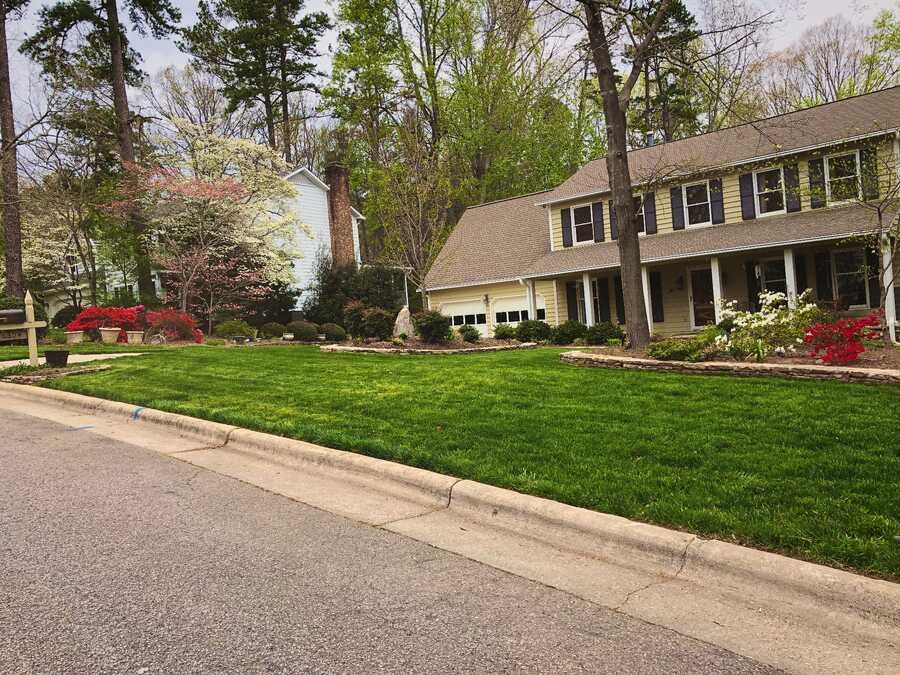
Sod is the fastest way to get a lawn, and it’s also the easiest way to waste a few thousand dollars. The difference is almost never the sod. It’s what happens to the ground underneath it in the days before the pallets show up.
Capstone Landscapes installs sod across Wake Forest, Rolesville, and northern Wake County. Rick Linder has been in the landscaping business over 25 years. Call or text (919) 671-7296 for a free estimate.
Why builder sod dies in year one
If you bought a new build in Wake Forest or Rolesville in the last few years, you probably watched this happen. The lawn looked perfect at closing, thinned out over the first summer, and by the second year you had more weeds than grass in half the yard.
That’s not bad sod. It’s sod laid on compacted subsoil. During construction the topsoil gets stripped, heavy equipment packs the clay underneath into something close to brick, and at the end a thin layer of soil goes down and the sod goes on top of that. It looks finished. It roots into an inch or two of loose material and then hits a layer it can’t push through.
Grass with two inches of root cannot survive a Piedmont July. That’s the whole story.
What we do before the sod arrives
Most of the work on a sod job happens before a single roll is laid.
- Kill or strip whatever is there, so you’re not laying new grass over old weeds
- Break up the compaction, so roots have somewhere to go
- Amend the soil where it needs it, working organic matter into the top few inches of clay
- Fix the grade, so water leaves instead of pooling. If there’s a drainage problem, this is the moment to deal with it
- Apply starter fertilizer and roll the surface smooth, because every bump and dip you leave is permanent
Then the sod goes down tight, seams staggered, cut clean around beds and hardscape, and rolled so it makes contact with the soil.
If your yard has a low spot that holds water, tell us before we quote sod. Laying turf over a drainage problem buries it instead of fixing it, and we’d rather handle the water first.
Which grass for your lot
Wake County sits in the transition zone, which means both cool-season and warm-season grasses will grow here and neither one is perfect. The choice comes down to how much sun the yard gets.
Tall fescue for shaded and partly shaded lots, which covers most of the older neighborhoods around Wake Forest with mature oaks and poplars. It stays green through winter, tolerates shade better than anything else that will grow here, and it needs overseeding every fall because it doesn’t spread on its own.
Bermuda for full sun and hard use. It loves our summers, repairs itself by spreading, and handles foot traffic that would destroy fescue. It also goes completely dormant and tan from roughly November to April, and it will not tolerate shade at all.
Zoysia for full sun where you want a denser, finer lawn and don’t mind paying more for it. Slower to establish, excellent once it’s in, dormant in winter like bermuda.
The mistake we see most is bermuda or zoysia sod on a shaded lot because someone liked how it looked at the sod farm. It thins out within two seasons and there’s no fixing it short of starting over.
When to lay it
Fescue sod goes down best in fall, roughly September through November, for the same reason fall is the right time to seed. Spring is workable if you can commit to watering it through the first summer.
Bermuda and zoysia are the opposite. They want heat, so late spring through summer is their window. Sod them in November and they go straight into dormancy without rooting.
Sod can be installed outside those windows and often is. It just needs more water and more attention to get established.
Watering new sod
This is the part that decides whether it takes. New sod has no root system, so it depends entirely on you for the first few weeks.
Water heavily the day it goes down, enough to soak through the sod and into the soil beneath it. Keep it consistently wet for the first two weeks, then start backing off frequency while watering longer each time, which pulls the roots downward. By week four or five you should be on a normal deep-and-infrequent schedule. Tug a corner: if it resists, it’s rooted.
Stay off it as much as you can for the first couple of weeks, and wait until it’s rooted before the first mow.
Get a free estimate
Call or text (919) 671-7296 or email capstonelandscaping@gmail.com. We’ll look at the sun, the soil, and the drainage, and tell you what will actually live there.
Serving Wake Forest, Rolesville, North Raleigh, Youngsville, Wendell, Zebulon, Knightdale, and Garner.
Common questions
Sod or seed?
Sod costs more and gives you a lawn immediately, which matters on a slope that’s eroding or when you’re selling. Seed costs less and, for fescue in fall, often ends up with a deeper root system because it grows in place. For bermuda and zoysia, sod is usually the practical choice.
How soon can I walk on it?
Light foot traffic after about two weeks. Normal use once it’s rooted, usually three to four weeks in the growing season.
Do you remove the old lawn?
Yes. Laying sod over existing grass and weeds is how you get an uneven lawn with the old weeds coming back through.
Can you do just part of the yard?
Yes, and it’s common. Front yard only, a strip along the street, or repairing an area that washed out. Matching an existing lawn works best when we can source the same grass type.