
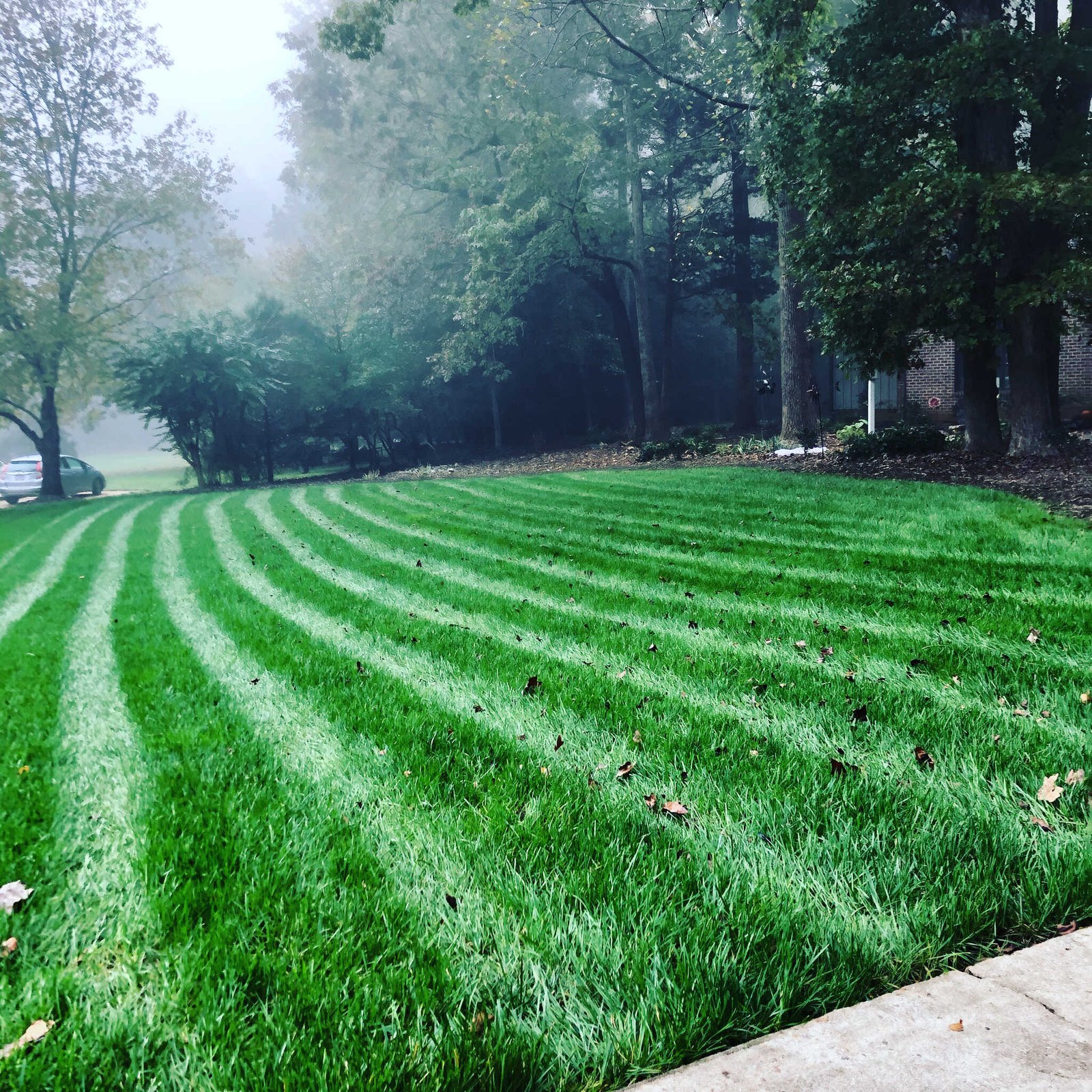
If you have a fescue lawn in Wake Forest, aeration and overseeding is the single most important thing you do to it all year. It’s also the one job with a window you can’t move. Mid-September through mid-October. Miss it, and you’re waiting twelve months for another shot.
Capstone Landscapes is a family-run crew based in Rolesville, and we aerate and overseed lawns all over Wake Forest every fall. Call or text Rick at (919) 671-7296 to get on the schedule. We start booking in August and the good dates go first.
Why Triangle fescue thins out every single year
Tall fescue is a cool-season grass, and we’re asking it to live through a North Carolina summer. That’s the whole problem in one sentence.
Brown patch shows up in June once nighttime temperatures stop dropping below the mid-70s. July and August bring heat dormancy, and a lawn that looked perfect in May goes thin and patchy by Labor Day. Most homeowners assume it’s coming back on its own. Some of it does. The bare spots don’t.
Here’s the part people miss: fescue is a bunch-type grass. It doesn’t run. Bermuda and zoysia send out runners and fill their own gaps, which is why those lawns recover without help. Fescue grows in clumps and stays where you put it. Every bare patch you have right now will still be bare next spring unless somebody puts seed in it.
That’s what overseeding is. You’re not fixing a sick lawn. You’re replacing the plants that died.
Why the window is so narrow
Mid-September hits a sweet spot that doesn’t happen twice a year. The soil is still warm enough for fast germination, the air has cooled off enough that seedlings aren’t cooking, and disease pressure has dropped way down from where it was in July. New grass then gets fall, winter, and spring to build a root system before it has to survive its first summer.
Spring seeding is the mistake we see most. It germinates beautifully in April, looks great in May, and dies in July, because six weeks of root growth is not enough to carry a fescue plant through a Piedmont August. It’s the same seed and the same money, and by August you can’t tell it was ever there.
NC State Extension’s home lawn calendar for the Piedmont puts the target at mid-September for a reason. We build our fall schedule around it, and it fills up.
What we actually do
We core aerate. That means pulling actual plugs of soil out of the ground and leaving them on the surface to break down, not just poking holes with spikes. On Wake County clay the difference matters, because spiking compresses the soil around the hole and makes the compaction worse. Pulling a core gives the soil somewhere to expand into.
- Mow the lawn short and clear the debris so seed can reach soil
- Core aerate, usually two passes in different directions on compacted or heavily used lawns
- Overseed with tall fescue at roughly 6 pounds per 1,000 square feet for an existing lawn, heavier where it’s thin or bare
- Apply starter fertilizer, about 1 pound of nitrogen per 1,000 square feet, which is what Extension calls for in mid-September
- Come back in November for the second nitrogen application, the one that does most of the work on root development
We leave the plugs on the lawn. They look messy for a week or two and then they’re gone, and the soil and thatch they carry back down are part of the point.
Wake Forest lawns have two different problems
The older streets near downtown come with mature oaks and poplars. Beautiful trees, hard on turf. They shade the lawn, they drink the water first, and they drop leaves in October and November right when new seedlings are least able to handle being buried. Fescue is the right grass for those lots, but the seeding rate needs to be heavier and the leaf management has to stay on top of it.
Then there are the newer builds out toward Heritage and Wakefield. Different situation entirely. The builder scraped the topsoil off, graded around the house, and left compacted subsoil under a thin layer of whatever they put down at the end. Water sheds off it instead of soaking in. Aeration helps a lot on those lots, and on the worst of them we’ll talk to you about amending the soil or fixing the grading first, because seed on top of concrete-hard clay is money you won’t get back.
We work both kinds of property across Wake Forest, Rolesville, and North Raleigh, and we’ll tell you honestly which one you’ve got.
Your job after we leave
This part is on you, and it decides whether the whole thing works.
Water light and often. Not deep and infrequent, which is the advice for an established lawn and exactly wrong here. New seed sits in the top half inch of soil and dies if it dries out once. Short cycles, two or three times a day for the first two to three weeks, then back off gradually as it fills in.
First mow at about 3 to 4 inches. Sharp blade, and don’t scalp it. A dull blade tears young grass out by the roots instead of cutting it.
Stay ahead of the leaves. A mat of wet oak leaves will smother new seedlings in under a week. Blow them off gently rather than raking hard, which pulls seedlings up with them.
No pre-emergent this fall. It doesn’t know the difference between crabgrass and the fescue you just paid for. Wait until late February.
Get on the fall schedule
Estimates are free and there’s no obligation. Call or text (919) 671-7296 or email capstonelandscaping@gmail.com, and we’ll come look at the lawn and tell you what it needs. If aeration and overseeding isn’t the right call for your property this year, we’ll tell you that too.
We serve Wake Forest, Rolesville, North Raleigh, Youngsville, Wendell, Zebulon, Knightdale, and Garner.
Common questions
When is the best time to aerate and overseed in Wake Forest?
Mid-September through mid-October, with mid-September being ideal. That gives seedlings enough time to root before winter and a full spring to establish before their first Piedmont summer.
Do I need to aerate every year?
On Wake County clay, most fescue lawns benefit from it annually. Sandy or unusually loose soil can go every other year, but that’s rare around here.
Can I aerate and overseed in the spring instead?
You can aerate in spring. Overseeding in spring usually fails, because the new grass doesn’t have enough root depth to survive July and August here.
How long until I see grass?
Tall fescue typically germinates in 7 to 14 days with consistent moisture. A full, thick lawn takes the rest of the fall and into spring.
Should I bag the plugs?
No. Leave them. They break down on their own in a week or two and return soil and organic matter to the surface, which is part of why core aeration works.