
If water sits in your yard for a day or two after every decent rain, that’s not bad luck. It’s a grading or drainage problem, and it doesn’t fix itself. It usually gets worse, because standing water kills the grass holding the soil in place, and once the grass is gone the low spot deepens.
Capstone Landscapes has been fixing drainage across Wake Forest, Rolesville, and northern Wake County for years. Rick Linder has been in the landscaping business over 25 years, and drainage is the work we get called about most in winter and early spring. Call or text (919) 671-7296 for a free look at it.
Why so many Wake County yards do this
Red Piedmont clay is the short answer. Clay holds water instead of letting it through, and when it’s compacted it may as well be pavement. Sandy soil drains. Ours doesn’t.
The longer answer involves how houses get built here. On a new lot the builder strips the topsoil off, runs heavy equipment across the subsoil until it’s packed hard, grades the yard to move water away from the foundation, and spreads a thin layer of soil over the top at the end. That grading protects the house. It does not necessarily protect the rest of your yard, and water pushed off the foundation has to end up somewhere. Usually that’s a back corner, or your neighbor’s side yard, or a strip along the fence line that never dries out.
Older neighborhoods have a different version of the same problem. Decades of settling, tree roots, added patios and additions, and downspouts that were never extended past the foundation.
Three different problems that look identical
Standing water in the yard has a few common causes, and they get fixed in completely different ways. Guessing wrong is how people spend real money and still have a wet yard. Here’s how we tell them apart.
It’s a downspout problem if the wet area starts near the house and fans out from a corner. A roof sheds an enormous amount of water, and a downspout that dumps at the foundation puts all of it in one spot. This is the cheapest fix on the list, and it’s worth ruling out first. Buried pipe carrying the water 15 or 20 feet out to a pop-up emitter solves a surprising number of “drainage problems.”
It’s a grading problem if the water pools in a defined low spot away from the house and the ground around it is dry. Something in the yard slopes the wrong direction, or doesn’t slope at all. The fix is dirt and a machine, not pipe. Regrading a low area so water keeps moving is usually cheaper and always lower-maintenance than burying drain that shouldn’t be needed.
It’s a subsurface problem if the whole area stays soggy for days even where there’s no visible puddle, or if water seeps out of a slope. That’s water moving underground through the soil and hitting a layer it can’t get through. That’s what a French drain is actually for, and it’s the only one of the three where a French drain is the right first answer.
Plenty of yards have two of these at once. We’d rather come look and tell you it’s a $200 downspout fix than sell you a drain you don’t need.
What we install
- French drains. A trench, filter fabric, washed stone, and perforated pipe set to a consistent fall, carrying water to a place it can safely leave. Done right you never see it again. Done wrong it silts up in two years, which is why the fabric and the washed stone matter more than the pipe does.
- Regrading and swales. Reshaping the ground so water keeps moving on its own. No pipe to clog, nothing to maintain.
- Downspout extensions and pop-up emitters. Buried, out of the mower’s way, discharging where you want it.
- Catch basins and channel drains. For low points that collect water faster than the soil can take it, and for the strip where a driveway or patio meets the lawn.
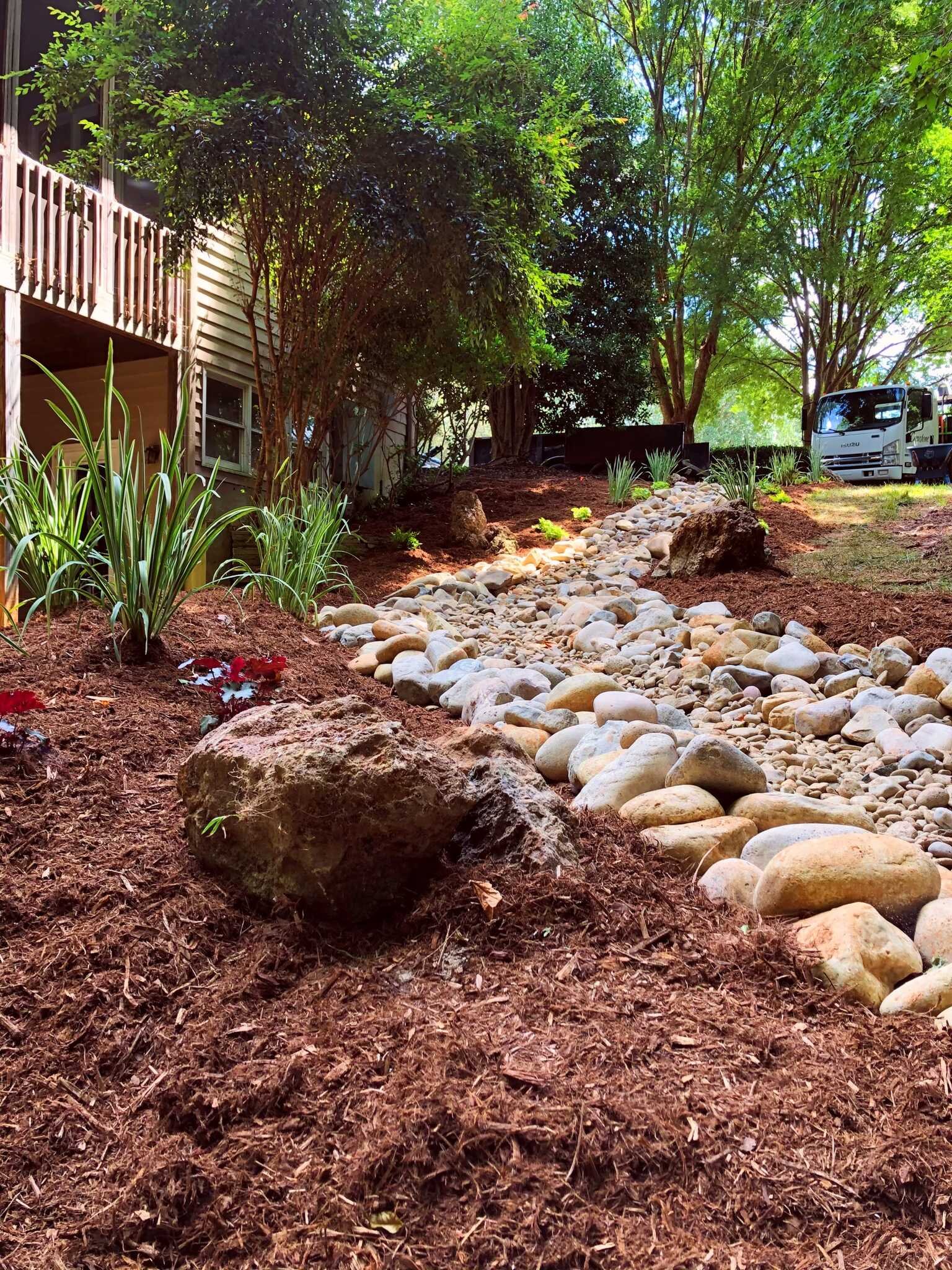
- Dry creek beds. When the water has to cross the yard anyway, a stone channel handles it and looks like it belongs there.
- Erosion control. Slopes that wash out every storm, bare areas under downspouts, bare ground along a treeline.
Whatever we dig up, we put back. Sod or seed goes over the trench, and within a season you shouldn’t be able to find it.
Why call a landscaper and not a waterproofing company
Search for drainage help around here and most of what comes back is crawlspace and foundation waterproofing. Those companies do good work on the problem they solve, which is water already getting into your house. If your issue is a yard that won’t dry out, a soggy back corner, a slope washing out, or grass that won’t grow in a wet strip, that’s a landscape and grading problem.
It’s also worth saying that fixing the yard is often what keeps water away from the house in the first place. Cheaper to move water before it reaches the foundation than after.
The best time to deal with it
Winter and early spring, honestly. Not because the work is easier, but because that’s when you can see the problem. A yard that looks fine in August will show you exactly where the water goes in February. If you’re reading this after a storm and there’s water sitting out there right now, take a picture. That photo is worth more to us than any description.
We also handle drainage as part of larger work. If you’re putting in a patio or a new lawn, getting the water right first is the difference between a project that lasts and one you redo.
Get it looked at
Estimates are free. Call or text (919) 671-7296 or email capstonelandscaping@gmail.com. We’ll walk the yard, figure out where the water is actually coming from, and tell you the cheapest thing that will fix it.
Serving Wake Forest, Rolesville, North Raleigh, Youngsville, Wendell, Zebulon, Knightdale, and Garner.
Common questions
How long does a French drain last?
Installed correctly, decades. The failures we get called out to fix are almost always the same two things: no filter fabric, so silt clogs the stone, or not enough consistent fall, so water sits in the pipe instead of moving.
Will it kill my grass?
We cut a trench, so there’s a visible line while it heals. We seed or sod over it when we’re done, and by the following season you generally can’t tell where it ran.
Where does the water go?
Somewhere it can leave safely, at a lower elevation. Usually a treeline, a ditch, a storm drain, or a daylight point at the low end of the property. What we won’t do is move your problem onto your neighbor’s lot.
Can’t I just fill in the low spot with dirt?
Sometimes, and if that’s all it needs we’ll say so. But if water is being fed into that spot from somewhere else, filling it just moves the puddle a few feet.
Do you handle the erosion after a slope washes out?
Yes. Usually that’s a combination of slowing the water down before it gets to the slope and stabilizing what’s there, with plantings, stone, or both, depending on how steep it is.